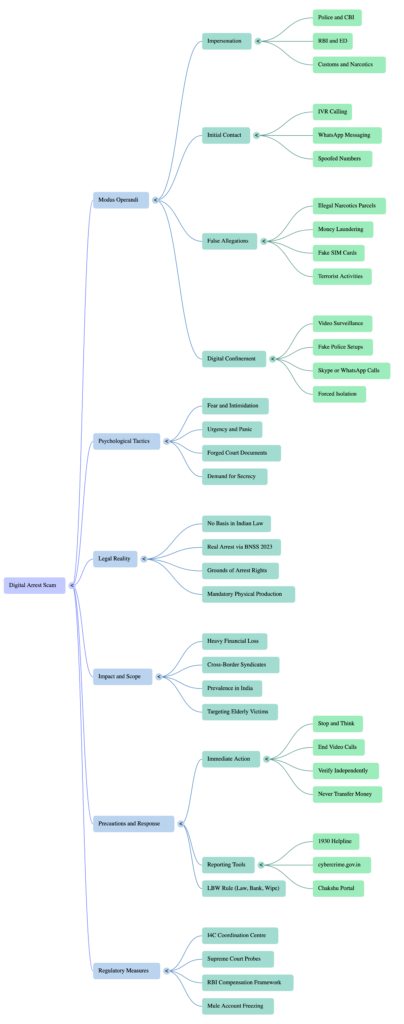

There is absolutely no concept of a “digital arrest” under Indian law, and genuine law enforcement will never arrest you over a video call or demand money to clear your name.
To supplement your summary, here is additional context on how these scams operate and the broader national response to this rising threat:
Psychological Manipulation and Forged Documents: These scams rely heavily on psychological manipulation, specifically instilling intense fear to bypass the victim’s rational thinking. Criminals frequently spoof numbers to appear as authorities from the CBI, RBI, Customs, or local police. To make the “digital confinement” believable, they isolate victims on continuous Skype or WhatsApp video calls, often using simulated police station backgrounds. Recently, scammers have escalated to presenting highly convincing forged documents, including fake FIRs, money laundering notices, and even fabricated Supreme Court orders bearing forged signatures of the Chief Justice of India.
The “LBW Rule” for Immediate Action: The advisory’s push for citizens to report suspicious activity is critical, as scammers rely on secrecy and isolation. To combat this, safety guidelines recommend adopting the “LBW Rule” if targeted:
- L (Law Enforcement): Do not panic or succumb to the demands. Immediately call the National Cyber Crime Helpline at 1930 or report the incident on cybercrime.gov.in.
- B (Bank): If you suspect your banking details are compromised or if you made a transfer, contact your bank instantly to block your cards, disable UPI, and freeze the accounts.
- W (Wipe): Wipe your devices completely, change your passwords, and ensure your system is secure from remote-access malware.
Financial Recourse and RBI Compensation: If a victim does transfer money, the first few minutes are crucial. Immediate reporting allows authorities to track the money trail and freeze beneficiary or “mule” accounts before the funds are laundered. Furthermore, starting January 1, 2027, a new Reserve Bank of India (RBI) framework will provide a safety net for victims: individuals who lose up to ₹50,000 to fraudulent electronic banking transactions can be compensated for up to 85% of their net loss (capped at ₹25,000), provided they report the fraud to their bank and the National Cyber Crime portal within five calendar days.
Supreme Court Intervention: The devastating financial and psychological impact of these frauds—which are often orchestrated by cross-border crime syndicates in Southeast Asia—has reached the highest levels of the judiciary. The Supreme Court of India recently took suo motu cognisance of the crisis, issuing notices to the Centre and directing the CBI to coordinate a pan-India investigation. The Court emphasized that fabricating judicial orders strikes at the foundation of public trust and has ordered authorities to collaborate with banks and telecom providers to dismantle these networks.
How do scammers use psychological manipulation in digital arrest scams?
Scammers execute digital arrest scams by attacking a victim’s mind before their money, primarily exploiting human emotions like fear, shame, and urgency. They rely on a sequence of calculated psychological control tactics to bypass the victim’s rational thinking:
- Establishing False Authority: Scammers impersonate trusted figures from law enforcement or government agencies, such as the CBI, RBI, Customs, or local police. To make the threat immediately believable, they sound highly confident, recite the victim’s basic personal details, and display convincing forged documents, fake FIRs, or fabricated court orders over video calls.
- Instilling Intense Panic: They abruptly accuse the target of severe illegal activities, such as drug trafficking, money laundering, or terror funding. This sudden threat is designed to make the victim believe that any delay in cooperation will instantly ruin their life, career, reputation, or family peace. This overwhelming fear paralyzes logical evaluation and provokes quick, impulsive reactions.
- Enforced Isolation and Secrecy: A fundamental tactic of the scam is demanding absolute secrecy. Fraudsters explicitly order victims not to speak to family members, friends, or a lawyer, falsely threatening that doing so amounts to “interfering with an investigation”. This isolation is a deliberate psychological control tactic designed to prevent the victim from seeking help or realizing they are being deceived.
- “Digital Confinement”: To maintain absolute dominance over the victim’s environment, scammers force them to stay on continuous, uninterrupted audio or video calls (frequently via Skype or WhatsApp) for hours. They often utilize simulated police station backdrops to make the virtual confinement feel incredibly real and inescapable.
- Creating Extreme Urgency: By combining severe threats with a high-pressure environment, criminals force victims to make rapid decisions. Under the guise of a time-sensitive emergency, they coerce the isolated victim into transferring funds to “safe accounts,” paying a “security deposit,” or revealing banking passwords just to clear their name or avoid immediate physical jail time.
What steps should I take if I am targeted?
If you find yourself targeted by a digital arrest scam, the first few minutes are critical to breaking the scammer’s psychological control. You should immediately adopt the “Stop, Think, Take Action” approach and follow these essential steps:
- End the call immediately: Do not try to continue the conversation to “clear your name,” as the scam only gets stronger the longer you stay engaged.
- Break the secrecy: Scammers will demand that you isolate yourself and not speak to anyone. You must immediately tell a trusted friend or family member what is happening, as breaking this enforced secrecy is often enough to shatter the scam.
- Do not comply with demands: Absolutely do not transfer any money for a “security deposit,” “fine,” or “safe account”. Furthermore, never share sensitive information like your Aadhaar, PAN, OTPs, screen-sharing access, or banking passwords. Remember that no genuine law enforcement agency will ever arrest you over a video call or demand money to stop an arrest.
- Preserve all evidence: Take screenshots and save call logs, phone numbers, WhatsApp chats, fake warrants, and any payment requests. Do not delete anything that could serve as potential evidence for an investigation.
- Verify independently: If you are genuinely worried about the allegations made against you, look up the official contact details of the claimed agency yourself, or physically visit your nearest police station to verify the claims.
If you have already transferred money or shared your banking details, execute the “LBW Rule” immediately (as above in this post).